
Specialised Investment Funds (SIF): A New Mutual Fund Category
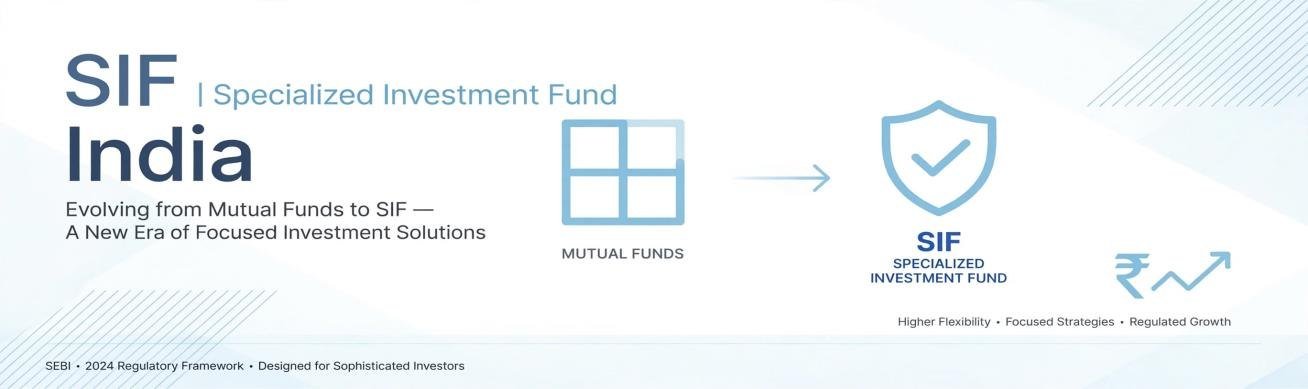
A new mutual fund category has been introduced, which is similar to traditional mutual funds. Like traditional mutual funds, it buys stocks expecting to gain from their upside.
Unlike traditional MFs, they can sell stocks first and buy them back at a lower price, gaining from a market decline. Thus, the name Long Short SIF. In simple terms, while traditional funds only benefit when markets go up, a Long-Short SIF has the ability to benefit from both sides of market movement.
What are the derivative strategies trying to do?
The derivative strategies used in SIFs have two clear objectives:
- To hedge the portfolio downside.
- To enhance the portfolio returns using short strategies.
Rationale behind Long-Short SIF
Markets don't always move in a linear manner. At various times, stocks, sectors or markets tend to move downward. We have all seen phases where even good stocks correct for some time.
A mutual fund strategy which takes advantage of non-linear stock/market movements to generate returns between some periods is effective. The rationale is to capture some return even when markets are not moving straight up.
Having said that, the primary objective is still to gain from the linear market movements. Short strategies are only a supporting tool, not the main driver.
SEBI Guidelines for SIF
As per SEBI, a few important guidelines to know:
- Minimum Investment requirement is Rs. 10 lacs.
- Max. 25% of the portfolio can be taken as unhedged short exposure through derivatives (this cap applies to the Equity Long-Short strategy; other SIF categories have their own limits).
- SIPs, STPs, Switches, and redemptions can be made similar to MFs, but the SIF portfolio at a single AMC per PAN should not go below the Rs. 10 lacs cost. In other words, you can manage it like your regular mutual fund transactions, but the threshold has to be maintained.
Final Take
SIF is an interesting bridge between traditional mutual funds and more advanced strategies. For investors who understand market volatility and are looking for a slightly more active approach to handle downside, this could be worth exploring. As always, suitability depends on your risk profile and asset allocation.
Reference
SEBI Circular SEBI/HO/IMD/IMD-PoD-1/P/CIR/2025/26 dated 27 February 2025, Regulatory framework for Specialized Investment Funds ('SIF') (effective 1 April 2025), issued under the SEBI (Mutual Funds) (Third Amendment) Regulations, 2024; read with the clarification circular SEBI/HO/IMD/IMD-PoD-1/P/CIR/2025/53 dated 9 April 2025. Minimum investment: para 4.1.1; short exposure limit: para 3.2 (Category 1, Equity Long-Short Fund); SIP/SWP/STP and redemption threshold: paras 4.1.3 and 4.1.4.2.
Mutual Fund investments are subject to market risks, read all scheme related documents carefully. This article is for education only and is not a recommendation to invest in any scheme.